Selling today means facing skepticism head on. Buyers are searching for any reason not to buy. The burden of proof is on you. It’s not about hoping a slick pitch will land. It’s about building trust every step of the way.
This blog is brought to you by Episode #419 of The Sales Hunter Podcast.
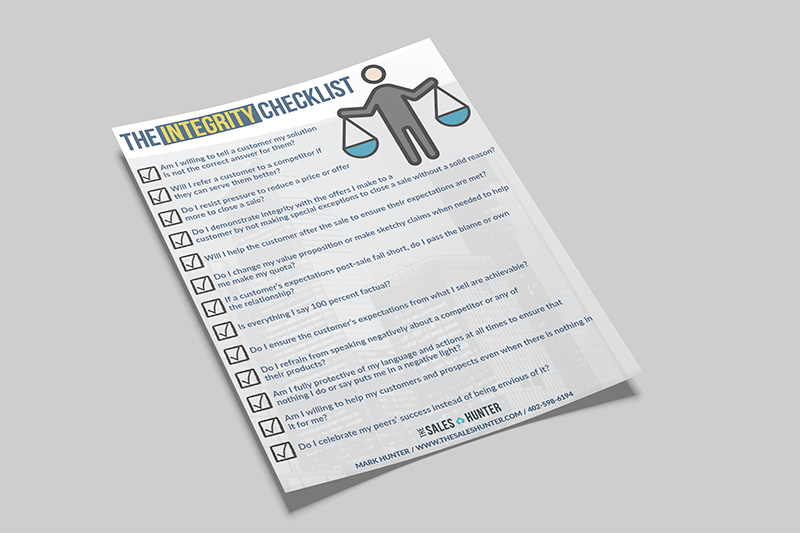
Integrity Isn’t Optional
There’s more misinformation out there than ever, and buyers know it. That means integrity isn’t just a selling point, it’s the foundation.
“We live in an era where there’s far more not to believe than there is to believe.”
Buyers have tuned out empty claims. They’re looking for sellers who back up their words with consistent, reliable actions. Demonstrate integrity from the first conversation onward.
Assume They Don’t Trust You
Never assume a buyer is on board just because they’re talking to you. They might be gathering intel for a competitor, or just being polite. That’s why surface-level questions don’t cut it.
Don’t ask, “Do you understand what I’m saying?” Instead, get the buyer talking. Ask them to share in their own words how your solution fits their situation. If they can’t do that, they’re not convinced. And if they’re not convinced, you’re not closing the deal.
Stop Sounding Like Everyone Else
Buyers are bombarded with copy-paste pitches every day. Don’t be another one. Stand out by letting your personality and your insights come through.
“Your customers don’t want to deal with a robot.”
Tailor the conversation. Bring unique insights about their business or their customers. That’s how you differentiate yourself from the pack.
Talk Less, Listen More
The person asking the best questions controls the conversation. Buyers don’t want a lecture, they want a dialogue. Ask a question, listen carefully, and then ask another that digs deeper.
Show you’re listening by following up on what they just said. This isn’t just good manners; it’s how you build empathy—and empathy is not a weakness.
“Empathy is a key trait in sales.”
Buyers respond when they feel understood. That’s when they start to share real information. That’s when trust is built.
Be Specific and Tell Stories
Vague claims fall flat. Specifics build credibility. Don’t say, “I’ve helped companies grow.” Say, “I helped one client increase sales by 16.5% over two years.” That specificity sets you apart!!
Write out your stories, then distill them into two punchy sentences. However, consistency matters; change your story, and you lose trust.
Preparation Wins
Trust is earned before the call even starts. Buyers check your online presence. They ask around because they want to know if you’re the real deal.
Establish credibility through your track record, your connections, and your insights. Then, once you have that seat at the table, keep earning it with every answer. The more specific you get, the more you connect your stories to their circumstances, the more likely they are to believe—and buy.
Make It the Buyer’s Journey
It’s not about your pitch. It’s about their process. Ask, listen, and align your stories to where they are and what they need. Get them talking (out loud!) about how your solution fits their world.
When a buyer starts sharing honestly, when they start owning the solution, that’s when belief happens. That’s when the close becomes comfortable for both sides.
Don’t Fear Skepticism, Use It!
Skeptical buyers force you to dig deeper, work harder, and create more value. That’s where lasting relationships begin.
Buyers don’t believe by default. Earn it. And remember, it’s not your journey, it’s theirs. Walk it with them, and the results will show.
Mark Hunter :
How can you close a sale when the buyer doesn’t believe you and how to fix it? Yes, it’s a problem we all face in sales, me included. And it’s the reason why we have to double down on both our messaging and our process. And I’m going to show you how in today’s show, and it begins right now. You’re listening to the Sales Hunter podcast with Mark Hunter, where the focus is to help you as a salesman, sell with confidence and integrity. And now, here’s your host. Why should customers believe you? Come on, let’s, let’s, let’s get over it. Why should they believe me? Sadly, we live in an era where there’s far more not to believe than there is to believe. It’s why I say more than ever, we’ve got to be be practicing integrity first.
Mark Hunter :
Selling. Okay. Customers are looking for even the slightest reason to not buy. And conversely, they need to see a lot of reasons as to why they should buy. You see, it’s simple to the customer, they’re in a no buy mindset. First, we have to accept this. We have to accept the reality. You see, we need to be asking them if they’re buying into what we’re saying.
Mark Hunter :
Yeah, yeah, yeah. Don’t assume too many salespeople, we assume because the customer takes our call, because the customer is willing to have a conversation, we assume that they’re buying into what we’re saying. We don’t know. They may be just buying into our information to use it against somebody else. You see, don’t assume anything. You’ve got to ask, but don’t think you can get by by simply asking a yes or no question. Do you understand what I’m saying? Wrong. It’s about asking them to share with you how they see what it is you’re talking about, how what you’re offering is going to help them.
Mark Hunter :
You see, you’ve got to get them to explain because again, if they can’t explain, it’s not going to happen. Now, don’t think for a moment that you have to go down this path once or you only go down this path once. No, you need to do it multiple times. But that’s good because it’s going to allow you to find out exactly what they’re buying into and what they’re not. You see, when you do this right, you’re moving the customer to a comfortable close. Yes. By being skeptical about the customer not believing you and going through this process, you actually move the customer to a more comfortable close. Okay, let’s tackle the issues and really unpack this more.
Mark Hunter :
You see, first of all, we have to be careful. Are we offering too many claims without enough proof? Now, let me stop right there and discuss what proof is. First thing, it’s not what we think is proof. It’s what the customer chooses to accept as proof. This is why you’ve got to set up every proof statement and it begins with how they see you. You see, think about this for a moment. If you ever been in a meeting where two people can say virtually the exact same thing, but one person they believe and the other person they doubt, well, the reason is is very simple is because everything is predicated upon how they view that person. This really means that your online presence, the pre information that the customers gathered about you is more important than ever.
Mark Hunter :
You see who you are, who you represent, the path that you’ve traveled, your contacts, all of that play into allowing the customer to be able to see what is the relationship that they have and should they value what it is that you say. You see, your proof statements are going to ring hollow. Your stories are going to ring hollow if the customer doesn’t buy into you See, it really does begin that you’ve got to start by demonstrating integrity. And what this does is this is going to help your stories have more value. And I’m going to unpack this more in future episodes. Okay, now number two, you sound like everyone else. You see, what can you say that will allow you to stand apart? This is not only what we say, but what we write, text, etc, you got to let your personality come through. You have to let your personality come through because you’ve got a gift.
Mark Hunter :
It’s you. Your customers don’t want to deal with a robot. That’s why they choose. That’s why they’ve chosen to talk to you. It’s why you’re talking to them. Second, regardless of what you sell, you need to understand who their customers are. This is true for both B2B and B2C. Nothing is bought in isolation.
Mark Hunter :
You need to understand the customer at a level they don’t see from other salespeople. This is how you’re going to stand out. You see, when you bring them insights, they are not getting elsewhere. This is how you stand out. Nothing’s going to help you stand out more than by doing this. I see this all the time in my work as I work with other clients and I really sell myself. I focus very heavily on understanding the customer’s customer and when I can bring insights. Now it may be the Exact same knowledge that the customer already has.
Mark Hunter :
It’s okay, here’s what they, here’s what they’re feeling. No other salespeople did that. No other salesperson shared that information. This salesperson, I was able to go deeper. But more chances than not, I’m able to uncover some insights that they weren’t even aware of. I’m able to look at things from a different perspective and it’s amazing at how that begins to change. You see, when I do this, it allows me to stand apart. Now what happens is the stories and the claims that I’m making now have more credibility.
Mark Hunter :
Let’s get into the next point. You’re talking too much and listening too little. What are the questions we’re asking? You know, customers don’t want a lecture, they want a conversation. It’s the questions you ask and the questions you ask after that initial question that matter most. Let me explain what I mean. You ask the customer question they share and then you ask them another question to build on further upon what it is that you, what they shared. Now what does this do? It demonstrates that you’re listening. It demonstrates that you value their opinion and you’re digging deep into it.
Mark Hunter :
It also allows you to begin demonstrating empathy. You see, surprisingly enough, empathy is a key trait in sales. Absolutely. Because if the customer does not feel like you are buying into them, guess what? They’re not going to accept it. Now don’t sit there and say, oh, empathy is a soft it’s way we wimp out. No, it’s not. No, it’s not. Because what it does is it allows the customer to open up more.
Mark Hunter :
Now remember, the whole topic we’re talking about here is why does the customer not believe you? Because the customer doesn’t believe you. Because they don’t feel you are hearing them. And we hear them by not talking as much. We hear them by asking more questions. We hear them more by demonstrating empathy to what it is that they’re saying now because remember, we’ve got to be willing to dig deep. And I’m talking here now about people who are on multiple sales calls. In other words, you’re, you’re dealing with a customer and you might be dealing with them. 3, 4, 5, 6, 7, 8, 9, 10 times during a closed sale.
Mark Hunter :
I incur this all the time in my business. And I see this with all the clients I work with. And it’s so easy for us to quickly think that it’s our journey. No, it’s not our journey. It’s the customer’s journey. That matters. And we only find out the customer’s journey by asking questions. You see, it’s the questions we ask that then get us answers that then begin to tell us what stories we should share.
Mark Hunter :
You see, I want you to use examples, I want you to use stories and I want you to be specific. You see, what’s, what’s interesting is we can’t be specific enough. Now let me share with you. If I just share somebody, oh, I’ve been able to help a lot of companies increase sales, that’s going to land flat because it doesn’t have credibility. But when I can say I’ve been able to help several companies and one in particular, I’ll share with you right now that I was able to help them grow their sales by 16.5% over a two year period. Now what, what happens is it has more credibility because I’m being specific. You see, this is key. But don’t just sit there and throw out specifics just to throw out specifics.
Mark Hunter :
You throw out specifics to augment, to support, to build on the answer to the question that they shared. Ah, you see what you’re getting to now you’re on the customer’s journey. Now here’s the thing. I want you to absolute practice, not practice. I want you to take the time this week to write down multiple stories. I want you to write down multiple stories and when you write them down, I want you to get absolutely specific. Now you need to get specific because this is the only way that the customer is going to share with you. But now the challenge is you can’t get into this, oh, I’m going to write a doctoral thesis for each story.
Mark Hunter :
No, it has to be able to be very short now. So what you’re going to do is you’re going to write the story out and it may be several paragraphs, but then you’re going to have to find a way to condense it down to just one sentence or two sentences because again, customer’s not going to sit through. But you need to have the paragraphs written out so you have the background information so you’re knowledgeable about this. Because again, it’s about demonstrating integrity. And you can’t sit here and, and share the story one way, one, one time and, and share it a different way, a different. No, no, no, you got to be absolutely consistent. Integrity matters. You see, what we’ve been talking about here today is, is very simply this.
Mark Hunter :
I am going to get the customer to believe me when I’ve done my homework ahead of Time. In other words, the customer knows because of the credibility I’ve established because of my online presence, because of other people I know in the industry, my time in, in the space, etc. Etc. They know that I have credibility. Okay? So that allows me to have a seat at the table. That’s fine. Two, I’m sitting there sharing with them specific stories, specific facts. Get specific based on the answers that they give me to the questions that I ask them.
Mark Hunter :
It is not a difficult path when you follow it. Right? But go back to what I said initially. You have to assume the customer is not believing you, and the more you can get the customer to share, hey, I just shared with you some ideas, some thoughts. How does that play out in the solution that you’re looking for? You ask them questions like that and you get them to unpack. Because when you get them to unpack that it does two things. One, it allows you to realize that now they’re believing you. And two, it gets them to a very comfortable state to where they will now feel comfortable closing a sale. You see, I like it when customers don’t buy into what it is that I’m saying.
Mark Hunter :
I absolutely like that. It’s great. I’m happy for it because it makes me work harder. And when I work harder, I create more value for the customer. And I also am working harder because I know that it’s the customer’s journey, not my journey. Hey. Each week we do two episodes. One a short one like this, second one where we do a long, more engaged interview with a subject matter expert.
Mark Hunter :
Do me a favor, would you leave me a review on your favorite podcast app? Now, I’ve been talking about my book, Integrity First Selling. I do hope you’ve picked up a copy. I do hope you’re reading it. Let me know what you think of it. Okay. Hey, my name’s Mark Hunter, the sales hunter. Great selling.