The Human Touch That Crushes Sales Targets
On a recent episode of The Sales Hunter Podcast, Mark welcomed Sam Richter, a leading expert in sales intelligence and digital prospecting, to tackle a problem every seller faces: response rates are tanking, and inboxes are overflowing with robotic outreach.
What separates meaningful prospecting from the generic noise? Sam shares why most sales efforts look and feel inhuman, and exactly how to rewire your approach.
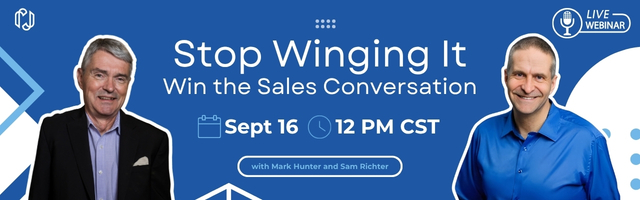
Join Mark & Sam for a practical 45-minute webinar on preparing for sales conversations that earn attention and build trust.
Register now to grab your spot!
Are You Just Blasting Out Emails?
The days of treating every name in the CRM the same are over.
Sam Richter calls out the core problem: too many reps are chasing silver bullets, searching for the perfect sequence or automation tool that will flood their calendars with meetings. But the reality, Sam warns, is much different. “Everybody’s looking for a magic silver bullet, and the reality is one doesn’t exist.”
The first fix? Know the difference between suspects and prospects. Suspects are everyone you could possibly target. They fit a demographic, but you don’t know if they care. True prospects have shown actual interest by responding, downloading something, or raising a hand.
Most reps treat them the same, blasting out slightly personalized scripts at scale. This results in “very stupid prospecting emails… not about me but about the salesperson,” as Mark calls it.
Lists vs. Lasers: Precision Over Volume
If it feels like activity metrics are driving your team, you’re not alone. But dialing for dollars no longer gets results. As Sam frames it, “A list is somebody who fits a demographic profile. A laser is someone who you really know that what you sell can help them achieve their goals more efficiently, effectively, profitably than they might be able to do on their own.”
Top sellers dial in on laser targets: people who are both relevant and reachable, not just names pulled from LinkedIn. Instead of sending everyone the same webinar invite or white paper, they filter by sales triggers and intent.
The Right Way to Personalize (It’s Not What You Think)
It’s tempting to let AI tools scrape LinkedIn and spit out “personalized” messages, but buyers see through this immediately. Generic “I saw your recent post” openings fool no one.
Instead, show genuine understanding. Sam recommends the THEM-US-FIT-PROOF framework:
- THEM: Do you understand what they care about?
- US: Do you know your own product’s strengths?
- FIT: Can you help them succeed better than before?
- PROOF: Have you delivered for someone just like them?
Prospecting isn’t rocket science, just disciplined research and authentic outreach. “If you haven’t read my post, don’t tell me you’ve read my post. I don’t care…I know you’re lying. I can tell,” Sam says.
Funnel Focus: Spend Time Where It Matters
Your time is your most valuable resource. Chasing 10,000 contacts delivers little ROI if you can’t move prospects to the next stage. The most effective sellers do deeper homework earlier, qualifying and customizing their approach for the right subset.
Today, technology and AI make researching prospects easier than ever. Sam’s approach: “It’s not a search engine. It’s a them engine.” Use every tool to learn what truly matters to your top targets before ever sending a message or scheduling a call.
The secret isn’t spending more hours, but spending them where it counts. As Sam puts it, “If your people aren’t using tools…that salesperson ought to be fired. What it’s showing is they don’t care.”
Where Real Value and Job Security Come From
With AI accelerating, there’s a myth that tech will replace sellers. Sam flatly rejects this: “AI cannot connect with a human. AI cannot build trust. AI doesn’t have wisdom…Those are the areas that I think a salesperson has to be focusing on moving forward.”
The job isn’t to peddle widgets, but to understand outcomes. Why is the buyer considering this solution now? What challenge are they trying to solve? As Mark shared, “It’s not the widget, it’s what the widget does. It’s the outcome of the widget. This is where sales is going.”
Rethink Your Prospecting Math
Here’s a simple formula every sales pro should know, courtesy of Sam:
- Number of people you reach (suspects)
- Percentage that move to interested (prospects)
- Percentage you actually close
- Average order size
Chasing more suspects with mass emails won’t move your win rate. The big lever is converting interested prospects to wins through relevance, trust, and true understanding.
Or, as Sam sums up: “I’d rather make fewer calls to the right people with the right message at the right time.”
Human Selling Wins Now More Than Ever
The future of prospecting isn’t robotic. It’s strategic, human, and value-driven. AI helps you research faster, but your advantage as a seller is being the expert, building relationships, and guiding buyers to solutions that matter.
The sellers who will win aren’t the ones who work twice as hard—they’re the ones who work on what matters.
“Sales Hunter Podcast is designed for one thing: to help you see and achieve what you didn’t think was possible.”
Ready to leave the robot prospecting behind? Get genuine, go deeper, and watch your results change.
Mark Hunter :
Why are you getting fewer and fewer responses to your prospecting emails? And why are you receiving more and more— hey, it’s time we really call out the elephant in the room. That’s the topic. I got a great guest today, and we’re going to dive into it. And the show begins right now.
Sam Richter :
You’re listening to the Sales Hunter Podcast with Mark Hunter, where the focus is to help you as a sales leader sell with confidence and integrity. And now here’s your host.
Mark Hunter :
Already today I’ve received half a dozen very stupid prospecting emails, not about me but about the salesperson. And oh, helping me today, Sam Richter. He is literally, without a doubt, probably the best individual possible to help dissect this problem. Why am I talking? Let’s get him on, on the show right now. Sam, welcome.
Sam Richter :
How you doing, Mark?
Mark Hunter :
I’m doing great. You do so much work behind the scenes in really helping? Because this is, this is a problem. Uh, we don’t know who we’re prospecting, we don’t know who we’re reaching out to. And what are the challenges that you find salespeople are dealing with to try to get to the right, you know, the right decision maker?
Sam Richter :
Yeah, I think the, the first part is everybody’s looking for a magic silver bullet, and the reality is one doesn’t exist. I think one of the things that salespeople have to do is delineate between suspects and and prospects, because they’re both important. Suspects are at the top of the funnel, right? At any given point in time, you might have 10,000, 30,000 suspects. These are people that you’re sending emails, emails of value to them. You’re not selling particularly. It could be inviting them to a webinar. It could be, you know, something, a study, a research report, whatever that you want to provide. Now, once someone responds, then they become a prospect.
Sam Richter :
A prospect to me is the person who goes into your CRM. Now, not everybody might follow that workflow. That’s just— I think it’s an important workflow based on what I’m about to say. So suspects, you, you want to be personal and customized, but it’s hard to customize 30,000 suspects. Uh, you, you might be able to put obviously their name And then just make sure it’s something of value to them. So if you’re— if you’ve got a study that talks about XYZ happening in the manufacturing industry, you don’t send that out to someone in the healthcare industry. Now, your prospects, once they become a prospect— and again, I define that fairly loosely— somebody who’s responded in some way. That could be they’ve signed up for a webinar, they’ve downloaded your white paper, Whatever it might be.
Sam Richter :
Now they’re in your prospect. Now they’re in your CRM. And those folks, I think what’s really important there is relevancy, a high degree of relevancy. Now, where does this tie into the big mistake that I see people doing? I see people treating them the same. So a lot of salespeople want lists. And as I like to say, there are some— and lists is what your suspect list is. For prospects, I think those folks, those are a laser. So there’s a difference between a laser and a list.
Sam Richter :
A list is somebody who fits a demographic profile. A laser is someone who you really know that what you sell can help them achieve their goals more efficiently, effectively, profitably than they might be able to do on their own. Now, that could be based on a sales trigger. Again, that could be Based on an event that they responded to, and those folks are getting highly, highly relevant communications.
Mark Hunter :
Now let’s break that down, because again, I think what we’ve got is we’ve got several different things here. You could have a lot of people then in that prospect list, and I’ll kind of push back a little bit, but I’ll let you get your perspective. Those are people who I think have interest, which is great. I want to be reaching out to them. But wow, how do I stay in touch with all of those people?
Sam Richter :
Well, I think again, it depends how many you have. So let’s say, you know, again, your suspect list, let’s just say it’s a, you’re going after everybody in an industry niche. Okay, you might have 50,000 people in your suspect list. Those are cold emails. They may not have opted in to receive that message. So your suspect list, again, it needs to be as niched as possible. So it could be an industry, could be based on a trigger event, you know, something going on, but it’s, it’s at a large group. And what you provide of value needs to be something that they’re interested in.
Sam Richter :
It could be a webinar, white paper, like I said, research report, survey, whatever they’re interested in. But again, those are— you may not have an opt-in list. Those are the lists you, you purchase through a tool. Your prospects, again, you, you might have lots of them. It might be more than a dozen. It might be a few hundred. It might be a few thousand. And so, what you need to do there is make sure that in your CRM system or whatever you’re using, that you have the places where you can really, really customize name of company, reason they reached out, sales trigger event.
Sam Richter :
And then, that’s where the beauty of AI can come in as well is you can really get very personal on aligning your CRM. I mean, it’s all— if you think about it, think about it in a spreadsheet format, right? You’ve got all these data, all this data in different columns. And so you have name of company, name of person, but then you have sales trigger, and then you have sales trigger, and maybe it’s based on what they responded to. They responded to an email, they attended a webinar. So, all those are opportunities for you to customize that message. What I don’t like, Marc, is seeing these emails where it’s just obvious somebody is mind your LinkedIn profile. And they’re— all they’re doing is they’re looking at the last post you made and they say, Marc, you know, that recent post you made about XYZ really resonates with me. No, it doesn’t, because you haven’t read it.
Sam Richter :
Because I know you haven’t read it because it wouldn’t resonate with you because it was targeted toward a very specific audience. So I think that’s the other part too, Marc, is there has to be some thought put into it. You can’t just throw everything at AI. You have to put some thought into, for lack of a better term, what are those columns and how are you going to personalize those columns so it feels a little bit more genuine?
Mark Hunter :
Okay. Now, I love where you’re going now because now you’re getting down because this is the problem. I get all these emails and so forth and You can clearly tell they said they’ve looked at this, but they haven’t. They said they’ve read that, but they haven’t. And again, AI can generate that. So what you’re saying is we’ve got to then pull this down and get far more specific with these prospects, ’cause I think there’s kind of multiple stages within prospects. There’s prospects and then there’s highly qualified prospects.
Sam Richter :
That’s right.
Mark Hunter :
Highly qualified, you know, now I know that. And so what’s kind of a methodology that you think exists To kind of get that, because ultimately I can’t spend my time with 10,000 prospects. I just don’t have enough time in the day. So walk me through, you know, what— how do we address this?
Sam Richter :
Well, I think— and again, I think you bring up a really good point. So there’s suspects, then prospects, and then there’s multiple levels of prospects, and we can talk about that in a little bit. But to directly answer your question, I think the key is with prospects— well, with everybody— but the key is, is to be genuine, to be authentic. If you haven’t read my post, don’t tell me you’ve read my post. I don’t care, okay? I know you’re lying. I can tell. You used an em dash even saying in the first sentence that you read my post. Nobody in the history of the planet has ever used an em dash, uh, in, in writing an email, okay? So I know it was written by AI.
Sam Richter :
If you don’t know what an em dash is, imagine like 4 hyphens connected together connecting 2 words. AI does it, humans don’t. So just be genuine and just say, hey, Mark. So again, they’re a suspect. Now they become a prospect. And let’s say broadly because of a sales trigger. Let’s say your sales trigger is— I’m just making this up— the person received a new promotion. Now that we know, maybe we see it on their LinkedIn, we saw it in a news article.
Sam Richter :
So, in your email, we might say, Mark, the reason I’m reaching out is I know you were recently promoted based on the article. And then you link to the article. So, again, maybe as the receiver of that, do I really believe that you read the article? No, but I know it’s relevant to me. You know, based on your new promotion, based on your new hire, I thought you might be interested in XYZ. Let me back up a little bit. I’m a big follower of the THEM-US-FIT-PROOF format. I learned that through Phil Sterlin, dear friend of mine at Summit Group. But sales, Marc, sometimes we try to make it really complex and it doesn’t need to be.
Sam Richter :
THEM. Do you understand them? What do they care about?
Mark Hunter :
US.
Sam Richter :
Do you understand your product? FIT. Can you help them achieve their goal a little bit more efficiently, effectively, or profitably than they might be able to do on their own?
Mark Hunter :
PROOF.
Sam Richter :
Show me you’ve done it for other people just like me. So, if you go into your communication with that thinking, what do we know about them? Well, what do we know about us? Is there alignment? Give me some proof. By the way, no complex sale, and I’m not even sure no easy sale, but certainly no complex sale has ever progressed forward unless there are the intersection of all 4 of those. So you figure out in your communication, where do those fit?
Mark Hunter :
Now, okay, now we’re bringing this list down into a tighter funnel because at the end of the day, the most valuable resource I have is my own time.
Sam Richter :
That’s right.
Mark Hunter :
Is there a methodology that you suggest, or is there a magic number that you think people can handle in terms of getting that granular? Well, or I should say getting that specific.
Sam Richter :
Yeah, I’ll tell you what I use once someone has. So now on the level of prospects, right? So we’ve gone from suspects, prospects. Now we’re going to highly qualified prospects. Those are people that have responded to an email. Hey, I’m interested. They’ve responded to a phone call, whatever it might be. Now, I’m gonna use AI. I’m going to use technology, but I’m going to leverage it to be— to really understand the them.
Sam Richter :
I call it the them engine, right? It’s not a search engine. It’s a them engine. What do we know about them? What do they care about? What’s going on in their world? What are their strategic initiatives? What is their potential SWOT analysis? How do they buy? Different buyers buy differently. The beautiful thing about technology and AI, we can get a lot of those answers. before we pick up the phone, before we have that Zoom call, before we send that highly customized email. But at that point, now I’m really doing my homework.
Mark Hunter :
Okay, I love where you’re going with this because really what we’re doing is we’re taking work that I think salespeople used to do further down in the funnel and moving it closer to the top to really getting us more specific to allow us, and this is a belief that I’ve had, I want to be able to spend more time with fewer people. That’s exactly what you’re talking about, doing more homework upfront.
Sam Richter :
But it’s more efficient, right? I mean, yes, in the old days, in the old days, you, you’d take people out for a 2-hour lunch. Okay, I don’t need to do 2. Why did we do that? We did that because we wanted to understand them. And frankly, they didn’t have Google either, so they needed to understand us. And so they were willing to give up 2 hours, we were willing to give up 2 hours. Well, let’s assume that if a highly qualified prospect is in that bucket, they’ve responded to something, they’ve already Googled us, they already are interested, they’ve raised their hand. I don’t have 2 hours to spend with them, but do I have 5 minutes? Yeah. Do I have 10 minutes? Yeah.
Sam Richter :
And I have to tell you, I mean, there are tools that I use that I’ll tell sales managers, if your people aren’t using this tool or something similar to understand the prospect before you pick up the phone, before they do a Zoom call, before they get in the car, then that salesperson ought to be fired. Because—
Mark Hunter :
Yeah.
Sam Richter :
What it’s showing is they don’t care. They don’t care. All they care about is their commission. Good salesperson is in it because they know that if they can help the other person, that’s the them, us fit, if they can help the other person, the fit part, the commission will come, the bonus will come, the sales will come. But you’re not going to have a long-term relationship if the salesperson, again, this is my opinion, is only interested in closing the deal, not interested in providing value.
Mark Hunter :
Okay. You’ve uncovered several things there. One is this whole thing that salespeople still don’t understand. Nobody will take a meeting with a salesperson without first checking out the salesperson and their company. Yeah, of course. I mean, that’s just a given. So, I mean, and yet I still see salespeople leading off with, hey, we’ve been in business 47 years, look at our factory, da da da da da da. Right, nobody cares.
Mark Hunter :
Nobody cares. But the other piece that I like where you’re going with this is it’s really helping us to uncover not interest, but intent early on. Because I think The more— the closer we get to intent, the faster the sales cycle is going to go. What you said specifically, it’s not about the commission. It’s about serving the customer. When we serve the customer, the commission is purely the scoreboard.
Sam Richter :
Yeah.
Mark Hunter :
That’s purely the points on the scoreboard. The touchdown, that’s when we were able to actually help the customer. the plays on the field. It’s interesting because you and I are going to be doing a webinar here in a couple of weeks and want people to check it out because we’re going to be unpacking this. You’ve got some products. You’ve got some really solutions that help people address this. Question for you. Are you seeing, because you work with thousands of salespeople all over, are you seeing salespeople spending more time at the top of the funnel? or at the bottom of the funnel compared to 3 or 4 years ago?
Sam Richter :
Well, that’s a great question. I think at the top of the funnel, I continually hear, I just need a list. Just give me a list. I’m going to build an email automation sequence. You know, again, they’re looking for some magic silver bullet. Here’s the reality, Mark. AI is going to change the way everybody buys. Like, we are still in the AOL dial-up phase of generative AI.
Sam Richter :
You know, wow, I can download a movie in 17 hours. It’s incredible. Um, we’re still in that phase. What do I mean? I don’t know if you’ve played with Muse yet. That’s the new Facebook, Meta, whatever they’re calling the company today, tool that actually helps— will actually buy things for you. All right, they just announced yesterday that they’re hiring an executive, a very experienced executive, to manage the enterprise Muse account. What does that mean? Well, it means that there’s probably nothing you sell that is not going to be bought through AI, recommended by a muse type of a product, right? So, if that’s true, then what is the only thing left that we have as a salesperson? Now, what I talk about in my sales keynotes is I use what’s called the SHIFT mindset. SHIFT.
Sam Richter :
And SHIFT is an acronym. S is streamlining workflow. H, harnessing expertise. I is innovation. F, Focus strategically, but T is the one I want to focus on now. T is thrive as a human, and that’s the only place, in my opinion, where salespeople are going to be able to differentiate moving forward. What is thrive as a human? It’s all the things that AI cannot do. AI cannot connect with a human.
Sam Richter :
AI cannot build trust. AI doesn’t have wisdom. AI can’t make a judgment call. AI has no empathy, courage, vulnerability. AI has no accountability. Those are the areas that I think a salesperson, uh, has to be focusing on moving forward. Because if you’re not providing value, if you’re not sitting down and saying, uh, listen, my son’s a financial advisor and I tell them this all the time, listen, in the future nobody’s going to be hiring you for asset allocation models or stock picking. Anybody can do that.
Sam Richter :
What they’re going to hire you for is to become the family CFO. What does the family CFO mean? They’re hiring you when they’re nervous, when they have questions for your advice. They know they can get into AI and they know they can even personalize AI. But that’s still not— no, I want to talk to a person. I want someone to tell me it’s all going to be okay. I want someone to sit down and say, look, you should buy versus lease that car. Or you should rent versus own that house. That’s— it’s the part that the AI can’t take away.
Sam Richter :
You know, I’ll say, listen, a lot of people think that AI is taking away our humanity. And I would say, no, it’s the exact opposite. AI is creating the efficiency that allows us to do what only humans can do. And that’s be human. So, how does this tie into what we’re talking about? As we get down to the intent, as you said, it’s really not just the intent of why someone wants to buy from you. But let’s peel back the onion a little bit. What are they trying to solve? That’s where the salesperson needs to provide value. They’re not looking to buy a widget.
Sam Richter :
They’re looking to buy a widget because having that widget allows them to do X. You need to figure out what X is because frankly, the widget might not even be the answer that they need, but they don’t know that because you’ve got the experience and they don’t.
Mark Hunter :
Okay. You’ve just said several things that are so key, because I think we’re seeing an evolution of sales. I go back during great economic periods, the salesperson was focused on closing the deal. Because leads just happen, leads just happen. And I think this is where, you know, and now what’s happened is, oh no, I don’t have enough deals to close, so it’s all about this lead generation. And that’s a false flag, that is a false flag, because ultimately AI is gonna take all that away from us.
Sam Richter :
Yeah.
Mark Hunter :
And our focus as salespeople has to be on just what you said, How do we create that trust, that relationship? How do we be the individual that can help the company, the person navigate through challenges? Because it’s not the widget, it’s what the widget does. It’s the outcome of the widget. This is where sales is going. Hey, I am so excited that you and I are gonna be doing a webinar here in just a couple of weeks where we’re gonna be unpacking this a lot more and sharing with the audience. a couple of tools that you’ve created that are really helping us get to that, I think, kind of Sales 3.0, where it’s back to this really deep relationship using AI to get us there faster.
Sam Richter :
Well, let me give you the math, Marc. Let me make it real simple. There’s only 4 levels you can— 4 levers you can pull as a salesperson. Number of people that you reach out to. That’s the suspect list. How many people are you reaching out to? The percentage of those people who say, hey, I’m kind of interested. Okay, those are the people we’re moving into the prospect list. Now usually that’s going to be 1-2%.
Sam Richter :
The percentage of those people that say, you know what, um, I’m gonna buy from you. Now a lot of people think that that’s— that the first one is the close rate. It’s not. No, there’s— people forget that first one, moving them from prospects Or excuse me, suspects to prospects. So, let’s say that you close. You get 5% of the people just for easy math to raise their hand, right? 50% of those people you actually close. And then, the other lever you can pull is the average order size. Now, which of those percentage points moves the needle the best? Is it talking to more people? No.
Sam Richter :
Is it even getting more people To say I’m interested, no. It’s people who say they’re interested in closing the deal. That’s the most important one. You do that with relevance. You do that with trust. You do that with really understanding them. But but to me, I see too many salespeople, sales managers in particular, say you’re not making enough calls. You’re not making enough calls, and people get bonus on making more calls.
Sam Richter :
No, I’d rather make fewer calls. You said this earlier. I’d rather make Fewer calls to the right people with the right message at the right time.
Mark Hunter :
Oh, spot on. That is, that is so valuable. And this is where I think the value of us as salespeople is not at risk due to AI. The value of us as salespeople increases because of AI, because we can use AI to do these tools. Hey, we’re going to put in the show notes the link to get registered for this webinar. coming up here very soon, but I do want you to check it out. Sam, uh, how do people get in touch with you?
Sam Richter :
Yeah, it’s just easy. You can Google me. I’m pretty, pretty easy to find. Sam Richter, R-I-C-H-T-E-R, uh, samrichter.com is my—
Mark Hunter :
there it is.
Sam Richter :
And, uh, sbrworldwide.com is my AI tools website.
Mark Hunter :
I love it. And, and like I said, if you can’t find somebody by Googling them, then they’re not relevant. And definitely Sam Richter, R-I-C-H-T-E-R. Absolutely, without a doubt. Hey, great talking with you. You’ve been listening to the Sales Hunter Podcast, new format. We’re going to one episode a week where it’s me doing a solo show, unpacking something, and occasionally a really special guest like we’ve had here today with Sam Richter. Sales Hunter Podcast is designed for one thing, to help you see and achieve what you didn’t think was possible.
Mark Hunter :
Do me a favor, leave me a review on your favorite podcast app. And of course, hey, check out any one of my books, whether it be Integrity First Selling, A Mind for Sales, or High Profit Prospecting. I’m Marc Hunter, The Sales Hunter. Great selling.